Home Workout Equipment: What's Worth Having
A plain guide to home workout equipment for beginners: which mat, bands, dumbbells and step are worth having, what each adds, and what to skip.
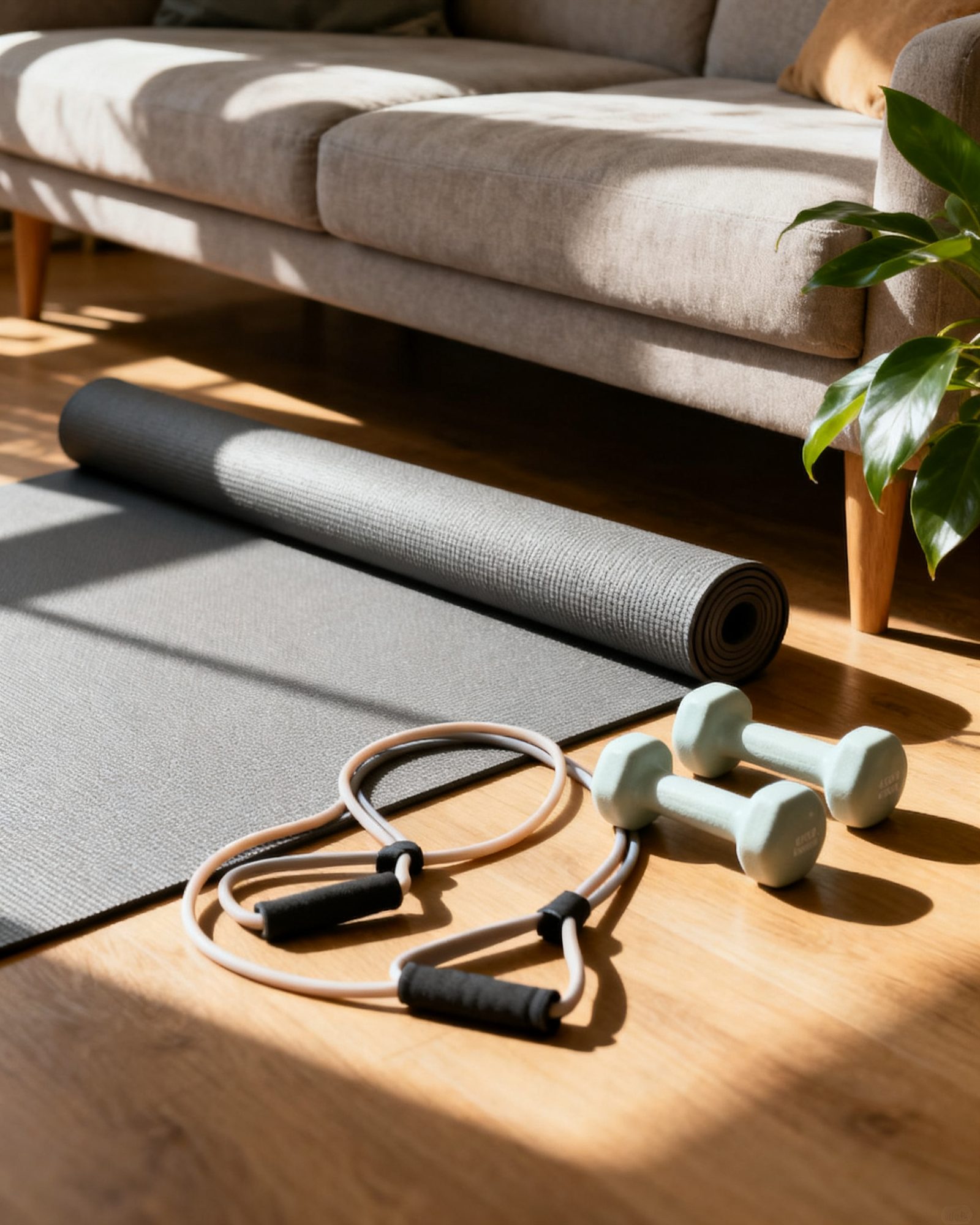
You do not need much to train at home. A mat, a set of resistance bands and one pair of dumbbells cover most beginner strength and mobility work, and a sturdy chair or step stands in for a bench. Everything else is optional. The list below explains what each piece adds, how to check it, and what to leave on the shelf.
The short list worth owning
| Item | What it adds | Good for | Skip if |
|---|---|---|---|
| Exercise mat | Cushion and grip for floor work | Stretching, planks, glute bridges, mat Pilates | You already have a non-slip rug and never lie on the floor |
| Resistance bands and loops | Adjustable resistance without weights | Rows, presses, glute work, warm-ups, travel | You prefer dumbbells for everything |
| A pair of light dumbbells | Load you can hold and progress | Squats, lunges, rows, presses, carries | You have a kettlebell or bands you will actually use |
| One kettlebell | A single weight for hinges and carries | Swings, deadlifts, squats, farmer carries | You are not yet confident with hip hinge form |
| Step or sturdy chair | Elevation and support | Step-ups, incline push-ups, split squats, balance | Your chair rolls or feels unstable |
| Doorway pull-up bar | A pulling option at home | Hanging and band-assisted pull-ups | The doorway is weak, the bar does not fit securely, or you have not checked it |
Start with the mat and bands. Add dumbbells when bodyweight and band work feel easy. A kettlebell is a good second weight if you enjoy hinge movements, but it is not essential.
Exercise mat
A mat gives grip and a little cushion for floor exercises. Look for one that does not slide on your floor and is long enough that your head and hips both stay on it. A thin mat is fine for most people; a thicker one helps if lying on the floor feels uncomfortable. Wipe it down after sweaty sessions and let it air dry before rolling it up.
Resistance bands for beginners
Bands are the most useful first purchase after a mat. A long flat band with handles or a loop, plus a set of short fabric or latex loops, covers rows, presses, glute work and warm-ups. Resistance comes from how far you stretch the band, so one band gives several levels of effort. Check bands before every session: hold them up to the light and look for nicks, cracks or pale patches. Replace any band that is worn, and never anchor a band to something that could tip or snap. Store them out of direct sun and away from sharp edges.
Dumbbells for home
A pair of light dumbbells lets you add load to squats, lunges, rows and presses. Adjustable dumbbells save space but take a moment to change; fixed pairs are quicker but take up room as you get stronger. Choose a weight you can lift for the repetitions you plan with good form, and add a little when the last repetition feels easy. The principles in free weights vs machines apply at home too: controlled form first, load second.
Kettlebell, step and doorway bar
A kettlebell is one weight that works well for hip hinges, squats and carrying. Learn the hinge with a light weight or a band before swinging. A step or sturdy chair is the cheapest piece of home gym equipment there is. A low, stable step suits step-ups; a solid chair without wheels, pushed back against a wall, suits incline push-ups and split squats. Test either one first by pressing down hard; if it shifts or rocks, use the floor instead. A doorway pull-up bar is only worth having if it fits your doorway securely and you have checked the manufacturer’s weight limit. If there is any doubt, skip it and use bands for pulling instead.
What to skip
Most home equipment is optional. Leave these until you have trained consistently for a while:
- Machines that only do one exercise and take up a whole room.
- Very heavy dumbbells or kettlebells bought before you know your working weight.
- Ab rollers, vibration plates and balance boards sold as shortcuts.
- Anything that promises a shape change; equipment builds strength and fitness, not a particular body.
- Second-hand bands of unknown age; you cannot tell how worn they are.
Setting up a corner that works
You need floor space about the length of your body plus a little, clear of furniture, and enough room to lie down with your arms overhead. Check the ceiling if you plan to press overhead. Keep the mat unrolled or easy to reach, bands on a hook, and dumbbells at the edge of the space so you do not trip. A mirror is helpful for checking form but not required; a phone propped up to record a set works too. If you live above someone, a thicker mat and slower, controlled movements reduce noise.
A simple session with this kit
Warm up for at least 5 to 10 minutes at light to moderate intensity, then work through a short full-body circuit:
- Bodyweight squats or goblet squats with one dumbbell.
- Band rows or dumbbell rows.
- Push-ups, on the floor, on your knees, or against a wall or the chair braced against a wall.
- Glute bridges or banded glute bridges.
- A carry across the room with a dumbbell or kettlebell.
Do 8 to 12 repetitions of each (for the carry, walk a few lengths of the room). A single set of each can be effective for a beginner; as you get stronger, build up to 2 to 4 sets, resting about 2 to 3 minutes between sets. Train each major muscle group on 2 to 3 days a week with at least 48 hours between sessions for the same muscles. Finish with a cool-down of at least 5 to 10 minutes, including a few stretches held for 10 to 30 seconds to mild tightness, not pain. More detail is in stretching and mobility.
If you are completely new to training, start with the plan in home workouts for beginners and add equipment as the movements become familiar.
What goes wrong
Buying too much too soon. A room full of equipment does not make a habit. Buy the mat and bands, train for several weeks, then add one thing.
Using worn bands. A band that has gone pale or cracked can snap mid-row. Check before every session and replace it.
Loading up before learning the movement. Learn each exercise with bodyweight or a light band first. Correct form and a full, controlled range of motion come before adding weight.
Holding the breath. Breathe out during the effort and in on the return. Do not hold your breath while lifting.
Training the same muscles on back-to-back days. Strength work needs recovery. Leave at least 48 hours before working the same muscle group again.
Mistaking soreness for injury. Delayed onset muscle soreness usually begins 12 to 24 hours after unfamiliar exercise, is often worst 24 to 72 hours afterwards, then eases. Sharp or sudden pain, joint pain, swelling, or pain that does not ease is not normal soreness: stop and talk to a doctor or physiotherapist.
Skipping the warm-up and cool-down. Both take at least 5 to 10 minutes and make the session feel better.
Ignoring a health condition. If you have a heart, metabolic or kidney condition, are pregnant or postpartum, are injured, or are unsure, talk to your doctor before starting or changing exercise. Stop and seek medical help for chest pain or pressure, fainting, severe breathlessness or dizziness.
Recovery is part of the kit
Equipment helps you train; recovery lets the training stick. Aim for 7 or more hours of sleep a night. Spread activity across the week rather than cramming it into one day. Gentle movement on rest days, such as a walk or easy stretching when muscles are warm, can help soreness ease. Soreness is normal at first and lessens as the body adapts.
The honest answer
A mat, a set of bands and one pair of dumbbells will take a beginner a long way. Add a step or sturdy chair from around the house and you have a full home gym essentials list. Everything else can wait until you know what you enjoy and what you will use.
Common questions
What home workout equipment should a beginner buy first?
Start with an exercise mat and a set of resistance bands. They cover floor work, rows, presses and warm-ups, and bands let you adjust resistance without buying several weights. Add a pair of light dumbbells once bodyweight and band exercises feel comfortable.
Are resistance bands as good as dumbbells?
Bands and dumbbells both build strength. Bands are lighter to store and travel well, and resistance increases as you stretch them. Dumbbells are easier to measure progress with and feel more like gym weights. Many beginners use both: bands for warm-ups and pulling, dumbbells for squats, presses and rows.
How do I know when to replace resistance bands?
Check them before every session. Hold the band up to the light and look for nicks, cracks, pale patches or thinning near the ends. Replace any band that shows wear, and store bands away from direct sun and sharp edges.
Do I need a pull-up bar at home?
No. A doorway pull-up bar is optional and only worth having if it fits your doorway securely and you have checked the manufacturer's weight limit. If there is any doubt about the doorway or the fit, skip it and use bands for pulling exercises instead.
How much space do I need for home workouts?
Enough floor space to lie down with your arms overhead, plus a little room around you. Clear furniture and check the ceiling if you plan to press overhead. A mat, bands and a pair of dumbbells fit in a corner or a cupboard between sessions.
Read next
Home Workouts for Beginners: No Gym Needed
Start home workouts for beginners with no equipment. Learn bodyweight moves, a sample session, safety tips, and how to progress at your own pace.
Rest Days and Recovery: Soreness, Sleep and Listening to Your Body
How many rest days you need, what muscle soreness after a workout means, how DOMS works, and how sleep and active recovery help you train at home.
How to Stay Motivated to Exercise When Motivation Fades
Motivation fades, but habits last. Learn how to stay motivated to exercise with small starts, tracking what you do, and planning for bad weeks.