Barre Class for Beginners: What to Expect
What a barre class is really like, from warm-up to mat work and the shake. Learn how barre compares to Pilates and yoga, and how to prepare for your first class.
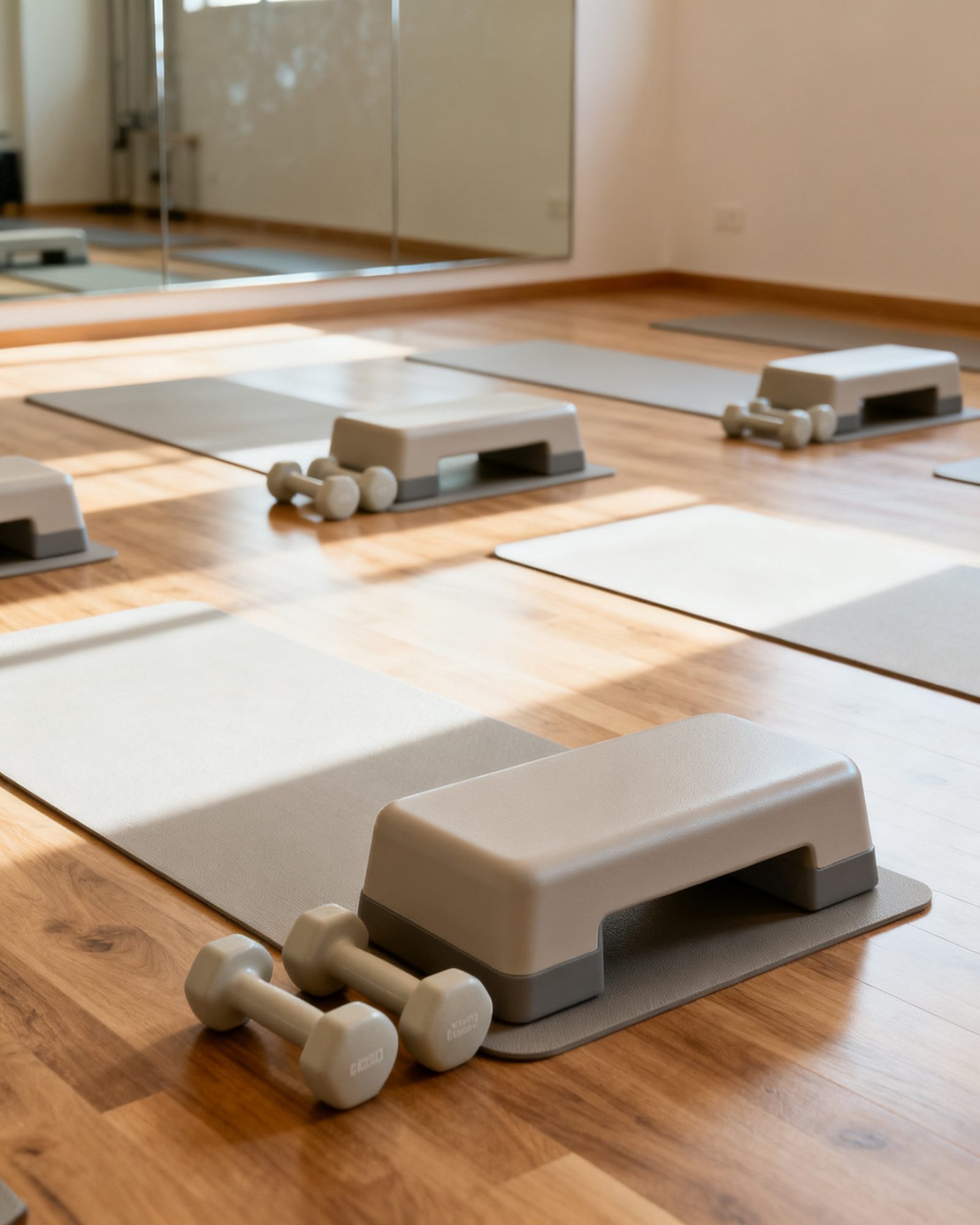
A barre class is a group fitness class that uses a ballet barre for support and combines small, controlled movements with light weights and bodyweight exercises, drawn from ballet, Pilates and yoga. No dance experience is needed. You work at your own level, and you can take every movement at a smaller range or a slower pace. The class is low-impact and set to music, and it usually moves from a warm-up through standing work at the barre, some mat work and a stretch.
What happens in a barre class
Most barre classes follow a similar shape, though the order and emphasis vary by instructor.
Warm-up
The class starts with a few minutes of gentle movement to raise your heart rate and loosen the joints: arm circles, small squats, side steps and simple standing stretches. This is your chance to settle in and find your space.
Standing work and small pulses
The main part of the class is standing work, often at the barre or with a chair or wall for balance. You might do small, pulsing squats, leg lifts to the side or back, and standing seat work. The movements are deliberately small and controlled. The aim is control and endurance, not speed or heavy load.
Light weights
Many classes use very light dumbbells for the arms and shoulders: small curls, presses and raises, often done for many repetitions. The weight is light on purpose. If you have no weights, bodyweight arm work works too, and you can do the same movements with no weight at all.
The shake
At some point your working muscles may start to tremble. This is a normal response to holding a muscle under tension for a while, and it is not a sign that something is wrong. It usually settles when you change position or rest. If the shake comes with sharp pain, stop and tell the instructor.
Mat work and stretch
The class often finishes on a mat with core work, glute bridges, and a series of stretches for the legs, hips and back. The stretch is part of the class, not an optional extra.
Barre, Pilates and yoga compared
| Feature | Barre | Pilates | Yoga |
|---|---|---|---|
| Support | Ballet barre, chair or wall | Mat or reformer machine | Mat |
| Typical emphasis | Small controlled movements, light weights, standing work | Deep abdominal and back muscles, posture, breathing, control | Postures, breathing and relaxation |
| Pace | Often set to music, continuous | Slow and controlled | Varies by style, from slow to flowing |
| Equipment | Light dumbbells, sometimes a ball or band | Mat, or reformer with springs | Mat, sometimes blocks or straps |
| Good first step if | You like music and a steady class | You want precise, focused movement | You want breath work and a calmer pace |
Barre borrows from both Pilates and yoga, but it is its own format. If you are choosing between class types, the group fitness classes explained page sets out how the main formats differ. For a closer look at the mat-and-machine side, see Pilates for beginners.
Who barre suits
Barre suits people who want a low-impact class with music, a steady pace and clear instruction. It is a good fit if you are new to exercise, returning after a break, or looking for something that builds control and balance without jumping or heavy weights. Because the movements are small and you can hold the barre, it is easy to scale down.
It is less suited to you if your main goal is heavy strength work. Barre uses light weights and bodyweight, so it does not replace a strength programme. The US Physical Activity Guidelines recommend muscle-strengthening activity that works all major muscle groups on 2 or more days a week, and the light loads in barre may not challenge every one of those groups, especially the back, chest and upper body. Pair it with strength training for beginners so the major muscle groups get loaded properly.
How to prepare for your first class
- Arrive early. Tell the instructor it is your first class and ask where to stand. A spot near the barre or wall gives you support.
- Bring water and a small towel. You will be moving for most of the class.
- Wear fitted but comfortable clothing. Loose trousers can get in the way of leg work.
- Ask about grip socks. Many studios ask for them for hygiene and grip; if you do not have any, ask what the studio prefers.
- Bring layers. You warm up quickly and cool down during the stretch.
Making it easier or harder
Barre is easy to adjust in the moment. The instructor usually offers a base version and a harder option.
Easier:
- Hold the barre with both hands for balance.
- Make the movement smaller and slower.
- Put the light weights down and use bodyweight only.
- Take a rest when you need one; standing still and breathing is part of the class.
- Keep the range of motion comfortable rather than deep.
Harder:
- Use one hand on the barre instead of two.
- Slow the movement down and pause at the point of most effort.
- Add a small pulse at the end of the range.
- Pick up the light weights for the arm section.
- Hold the position a little longer before you release.
What goes wrong, and how to avoid it
Holding your breath. Small, tense movements make it easy to hold your breath without noticing. Breathe out during the effort and in as you return, the same way you would in any strength work.
Letting the movement get sloppy to keep up. The class moves to music, and it is tempting to match the pace by swinging. Slow down instead. Control matters more than range or speed.
Locking the knees or sagging the hips. Keep a soft bend in the knees and the ribs stacked over the hips. If your lower back aches, check that you are not arching it to get more range.
Pushing through sharp pain. The shake is normal; sharp or sudden pain, pain in a joint, or pain that does not ease is not. Stop and talk to a doctor or physiotherapist.
Expecting barre to do everything. Barre is one part of a week. The guidelines for adults describe at least 150 to 300 minutes a week of moderate-intensity aerobic activity, or 75 to 150 minutes a week of vigorous activity, or a mix, plus strengthening on 2 or more days a week. Barre is mainly muscular endurance work rather than aerobic exercise, so it does not replace the aerobic activity, and with its light loads it may not cover all the strength work either.
Believing the marketing. Barre is sometimes sold with claims about changing the shape of your body. What the class actually does is build control, balance and muscular endurance, and it can help you feel better and move better. It does not promise a particular body shape, and no class does.
Ignoring a health condition. If you are pregnant, postpartum, injured, in pain, or have a heart or other health condition, talk to your doctor before starting or changing exercise. This page gives no programme for those situations.
What to expect afterwards
You may feel muscle soreness in the day or two after your first class, especially in the thighs, seat and calves. Delayed onset muscle soreness usually begins 12 to 24 hours after exercise, is often worst 24 to 72 hours afterwards, then eases. Gentle movement helps. Soreness is normal at first and lessens as your body adapts.
Aim for 7 or more hours of sleep a night if you are between 18 and 60, and give the same muscle groups at least 48 hours between strength sessions. Barre works the legs and seat hard, so treat it like a strength session: leave a day between barre classes, or between barre and a strength session that works the same muscles, and take an extra rest day if you are very sore.
A simple first-month plan
- Week 1: one barre class, taken at your own pace. Hold the barre as much as you like.
- Week 2: one or two classes. Try one section without the light weights.
- Week 3: add one strength session that works the major muscle groups, or a brisk walk on another day.
- Week 4: two barre classes and one or two strength sessions, spread across the week so the same muscle groups always get a day of rest in between.
Spread activity evenly over the week rather than saving it all for one day. Some activity is better than none, and activity of any length counts toward the weekly total.
Common questions
What is a barre class?
A barre class is a group fitness class that uses a ballet barre for support, with small, controlled movements, light weights and bodyweight exercises. It draws from ballet, Pilates and yoga. No dance experience is needed, and you can take every movement at your own level.
What should I wear to my first barre class?
Wear fitted but comfortable clothing that lets you move and does not get in the way of leg work. Many studios ask for grip socks, so check with the studio before you go. Bring water and a small towel, and arrive early to tell the instructor it is your first class.
Is barre good for beginners?
Yes. Barre is low-impact and easy to scale: you can hold the barre with both hands, make the movements smaller, and put the light weights down. Tell the instructor it is your first class so they can offer easier options.
Barre vs Pilates: what is the difference?
Barre uses a ballet barre for support and often includes light weights and music, with small pulsing movements. Pilates focuses on controlled exercises for the deep abdominal and back muscles, posture and breathing, on a mat or a reformer machine. Barre borrows from Pilates but is its own format.
Why do my muscles shake in barre class?
The shake is a normal response to holding a muscle under tension for a while. It usually settles when you change position or rest. If the shake comes with sharp pain, stop, tell the instructor, and talk to your doctor or a physiotherapist if it does not ease.
Read next
Types of Group Fitness Classes: Which One Suits You?
Compare spin, HIIT, Pilates, yoga, Zumba, barre, aqua aerobics and circuit classes: what each involves, effort, joint impact and how to pick a first class.
HIIT for Beginners: What a High-Intensity Class Involves
What HIIT is, what happens in a beginner class, how hard to push, how to make moves low impact, and how to fit HIIT into a safe week.
Pilates for Beginners: Mat vs Reformer and What a Class Is Like
New to Pilates? Compare mat and reformer classes, learn the core principles and common beginner exercises, and find out what a first class is really like.